How I Built 3 AI Bots with OpenClaw to Boost My Daily Workflow
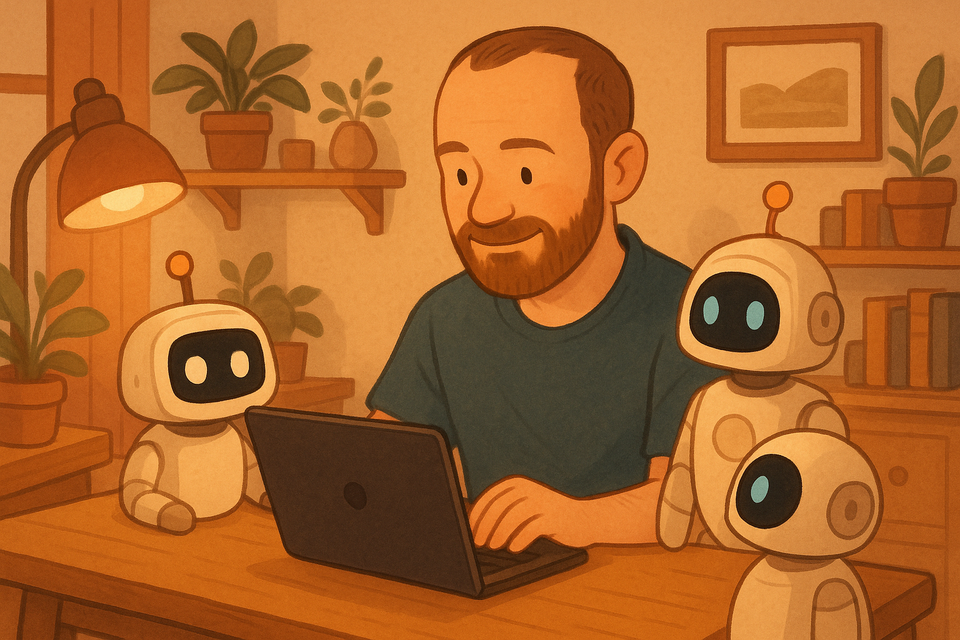
I didn’t start this purely as an AI experiment. I started it because my daily workflow was full of small frictions that kept stealing time and focus. But as I began building, it quickly became exactly that: an experiment in how far a few focused AI bots could go in improving the way I work.
In just a few days, three personal bots began handling parts of my writing, research, and technical execution loop — fast enough to feel like a real shift in how I work.
This article is a practical breakdown of what I built, what is already useful, and what still needs tuning. I built these bots with OpenClaw, an agent framework that lets me run specialized AI assistants with their own roles, prompts, and workflows.
Why I Started
I wanted to stay close to this new wave of AI agents and understand how these tools perform in real life. Between OpenClaw and models from companies like OpenAI and Anthropic, it felt like the right moment to move from curiosity to hands-on experimentation.
At a practical level, AI already made sense in both my personal and professional routines. Building my own bots was the logical next step: start small, define clear responsibilities, and increase autonomy only as trust and safety improve.
My Bot Stack
Right now, I use three bots, each with a clear role.
1) Mr. Toad (Senhor Sapo)
Mr. Toad is my writing and publishing assistant. I use him to shape ideas, structure drafts, refine text, and support lighter personal workflows.
2) Mr. Pigeon (Senhor Pombo)
Mr. Pigeon is my briefing bot. He runs recurring routines and helps me stay on top of politics, finance, Portugal news, and broader current affairs.
3) Mr. Fox (Senhor Raposa)
Mr. Fox is my technical execution bot. I use him for implementation-heavy work, tool building, document editing, and technical problem solving.
Technical Setup: Why I Split My Bots Across 3 VPSs
I host my setup on infrastructure I already had: 3 vps's running on my Synology NAS at home. I tested multiple configurations and, for speed and isolation, chose one per bot.
- Mr. Fox: more CPU and RAM for heavier technical workloads.
- Mr. Pigeon: lighter profile for research and briefing tasks.
- Mr. Toad: balanced profile for writing, research, and publishing support.
Model Strategy and Cost Concerns
I also looked into Anthropic models, but OpenAI has evolved significantly and, since I was already paying for a ChatGPT Plus subscription, I decided to keep things simple for now.
At this stage, I’m only using ChatGPT OAuth authentication through the subscription I already had, so this setup didn’t add any extra model costs on top of what I was already paying.
That said, I’m still paying close attention to usage and model strategy, because if I later move heavier workloads to API-based usage, costs can rise quickly without careful prompt and context optimization.
Real-World Use Cases
What stood out to me was how quickly these bots became useful. These were not edge cases I discovered after weeks of tuning — they were real tasks I used them for on day one. Even with an early setup, they were already removing friction from things I would normally do manually.
PDF Compression in Under a Minute
I had a scanned PDF from Apple Notes at around 20 MB. I asked Mr. Fox to compress it, and in less than a minute it went down to around 2 MB with normal quality.
Before, I would search random web tools, deal with ads and clunky UI, and waste time. This was faster and frictionless.
Live Article Workflow (Voice → Ghost Post Draft)
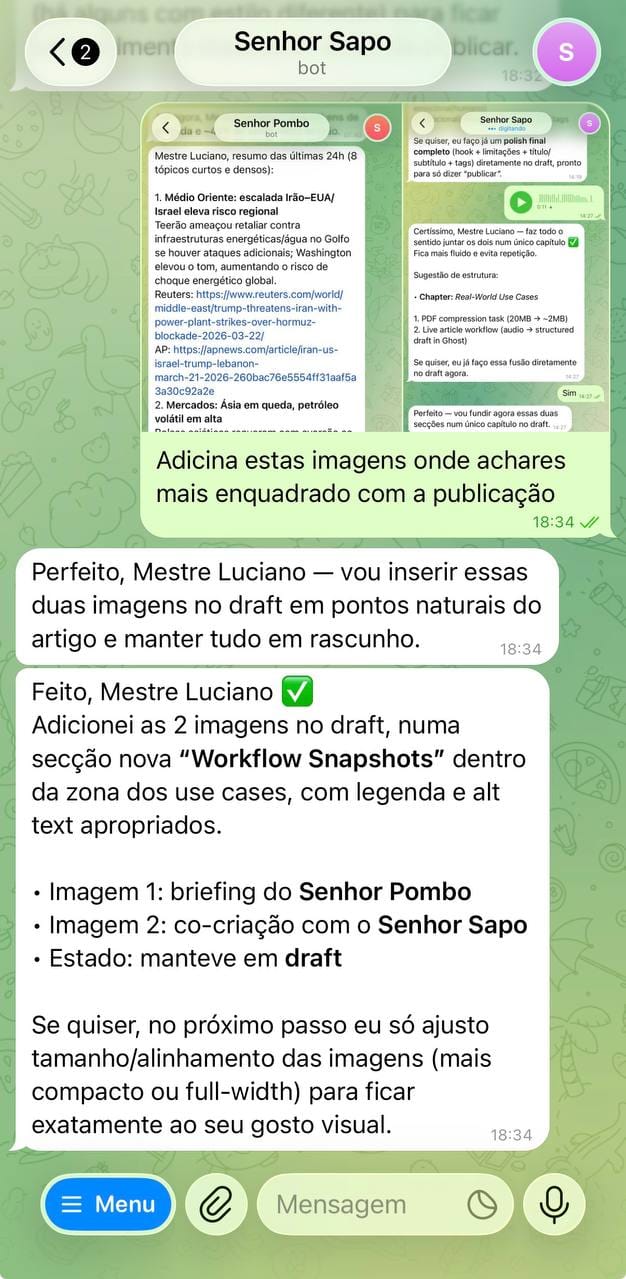
This article is actually being built with Mr. Toad as I go. I send voice instructions through Telegram with ideas, edits, or new sections, and he helps transform them into a clearer and more structured draft. Because he also integrates directly with Ghost, my blogging platform, those updates can flow straight into the publishing process instead of forcing me into the usual copy-paste loop between tools.
So this is not just an article about the workflow — it is part of the workflow itself.
Here’s a simple example of that workflow in practice. In this case, I asked Mr. Toad to add an image directly into the article draft inside Ghost, as part of the publishing flow rather than as a separate manual step.
Buying Research Assistant
Another useful pattern is purchase research. Instead of manually comparing many options, I can ask for filtered recommendations based on criteria, trade-offs, and practical fit.
What Changed My Mind About Productivity
The more I used OpenClaw, the more I started seeing AI agents as digital workers. If a task is mostly done on a computer, there is a good chance an agent can handle a meaningful part of it.
In my workflow, I give direction, let the agent run, and then review output with concrete feedback. This keeps human judgment in control while dramatically reducing execution time.
What used to take hours can often be compressed into minutes. In digital-heavy sectors — from IT and services to parts of creative work — this changes the productivity ceiling.
What Isn’t Working Perfectly Yet
No setup like this is frictionless, and mine is still early.
- Model usage uncertainty: heavier usage may require API-based models with higher cost.
- Prompt quality matters a lot: if context is not compact and precise, efficiency drops.
- Personalization is still in progress: some outputs (especially news briefings) still need tuning.
- Early-stage maturity: this is strong already, but not a fully optimized final architecture.
Where This Can Go Next
The potential is massive. Bots can interact with real tools and systems, including home automation workflows controlled through channels like Telegram.
OpenClaw can run local models too, which is great for control and privacy, but usually demands stronger hardware. For now, hosted paid models still tend to deliver better practical reliability.
What I’m Watching Next
For now, I want to keep watching how these three assistants behave in real life and learn where they can be trusted more. Over time, I expect to give them more responsibility as confidence grows, and I plan to keep sharing that journey here on this platform.
What excites me most is that these are not just three chatbots answering prompts. They are three assistants with access to their own computer environments, which makes the possibilities feel almost endless. That changes the interaction model completely: instead of the copy-paste loop that many people still use between ChatGPT and their productivity tools, the workflow becomes far more direct, integrated, and powerful.
Final Thoughts
I am genuinely optimistic about AI. In my professional life as a Senior Software Engineer, the last month already brought a major shift: I still control architecture and quality, but I write far less code by hand and supervise more agent-driven execution.
This transition is not only personal — my team is also adopting these tools, and we are delivering features in significantly less time.
We still do not know exactly where this lands long-term, but the direction is clear: with the right systems and oversight, one person can execute far more than before.
Member discussion