Mythos and the Meaning of a Model That Doesn’t Launch

What an unreleased Anthropic model may say about AI, cyber risk, and who gets access first
I’ve been working in software for more than 15 years, across product teams, enterprise environments, and a few different waves of “this changes everything.”
Some of those waves really did change a lot.
Cloud changed infrastructure. Mobile changed how people interact with software. DevOps changed how quickly teams can build and ship.
AI feels different.
Not because it is just another tool improvement, but because it seems to be changing the way value is created in the first place.
In the last few months, I’ve seen teams get a lot more done without growing headcount. I’ve seen strong engineers move faster, cover more ground, and work with a kind of leverage that would have sounded exaggerated not that long ago.
I’ve also seen companies react in completely different ways. Some take the opportunity to simplify. Others do what enterprises often do: add layers, create new process, build extra internal complexity, and slowly recreate the same friction the technology was supposed to remove.
That by itself is already interesting.
But the reports around Anthropic’s Mythos point to something bigger.
If the reporting is broadly right, then we may be looking at a model with meaningful offensive cybersecurity capability that is not being released to the public in the normal way. And if that is true, then this is not just another AI launch story, or in this case, a non-launch story.
It may be a sign that we are entering a different phase.
This is not just about better models anymore
A lot of AI discussion still revolves around familiar things: benchmark charts, demos, model rankings, launch cycles, context windows, reasoning quality.
That all matters. But it is starting to feel like the surface layer of the conversation.
What matters more now is what these models can do in the real world, inside real systems, at real scale, with real consequences.
And once you look at it that way, things get more serious very quickly.
Capabilities do not exist in a vacuum. They interact with messy institutions, uneven security, weak governance, rushed incentives, and attackers who do not wait politely for policy to catch up.
That is why a model not launching may now be just as important as a model launching.
Not launching is not always a failure
We are still mentally wired for product release logic.
A new model appears, benchmark numbers get shared, people debate who is ahead, the ecosystem rushes to integrate it, and then the cycle starts again.
That logic works when the downside is manageable.
It works much less well when the downside could spread far beyond the company making the release.
If a model crosses some threshold in offensive capability, especially in cybersecurity, then delaying or restricting access may be the most responsible thing a lab can do.
That should not automatically be read as weakness.
It may simply be restraint.
For a long time, the dominant logic in tech was basically: if it works, ship it.
Now we may be entering a phase where the harder question is: if it works too well, who pays for that?
That is a very different kind of conversation.
Cybersecurity makes this much more real
Cyber is one of the clearest places where the old logic starts to break.
In many areas of software, you can launch, learn, patch, improve, and iterate. That model has flaws, but it is survivable.
Cyber does not always work like that.
If AI lowers the barrier for high-impact attacks, then the “we’ll fix it later” mindset becomes much harder to justify. Defenders patch in cycles. They improve controls, investigate incidents, train teams, and respond under resource constraints.
Attackers do not operate in neat cycles.
They adapt constantly. They look for openings. They benefit from speed and asymmetry.
So if a model significantly improves offensive cyber capability, the question stops being “is this impressive?” and becomes “what risks are being pushed onto everyone else if this is widely released?”
That is not just a technical question. It is a social one.
The fairness question is real too
There is another part of this story that also matters.
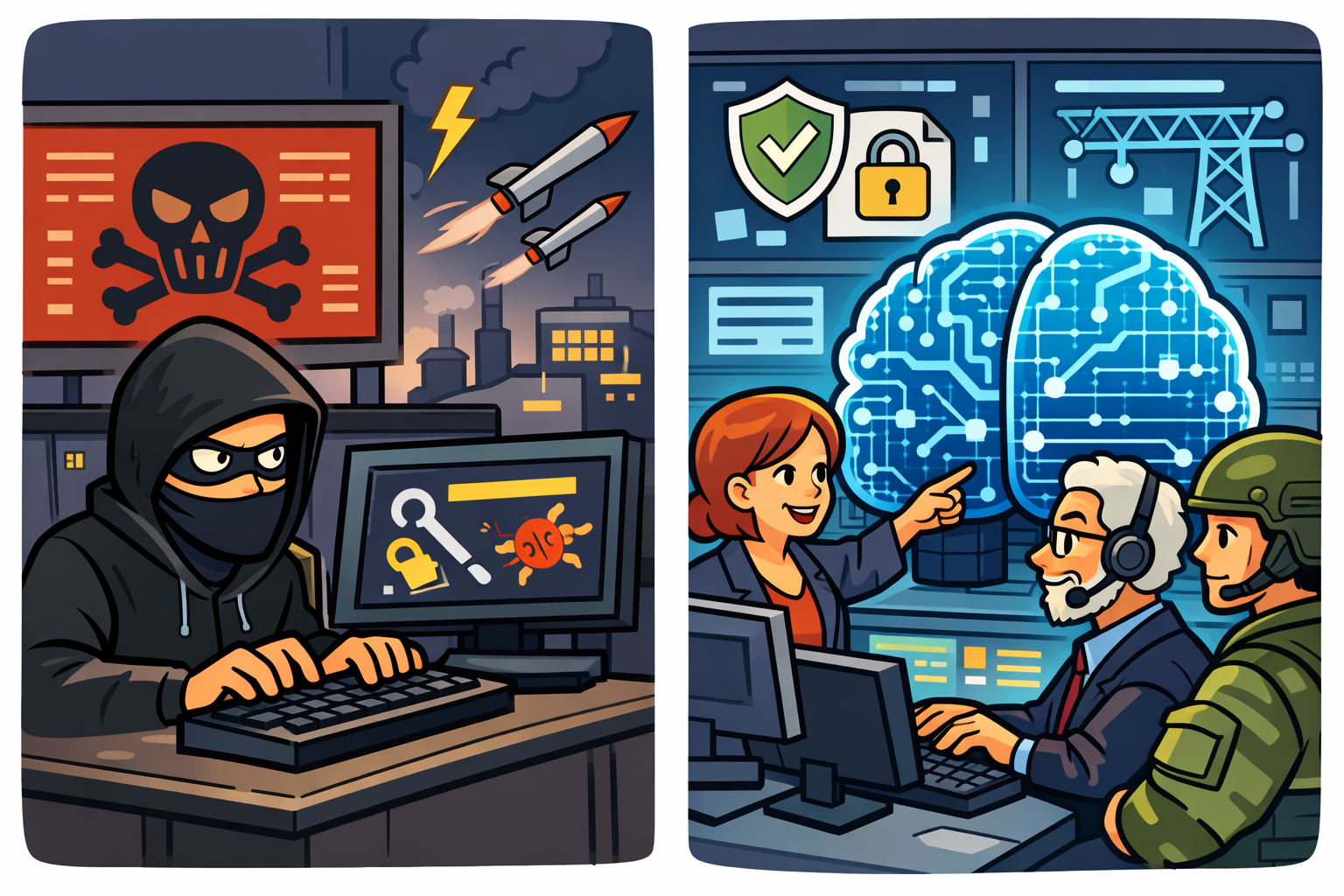
When a model is considered too risky for broad public access, but still becomes available to a smaller group of powerful institutions, people are naturally going to notice the imbalance.
On one level, that may be reasonable. If the goal is defensive use, then controlled access for major security actors or critical infrastructure organizations can make sense.
But that does not remove the tension.
Because from the outside, it can look like this: the public is told the model is too risky for general release, while large organizations still get access to the newest capabilities.
Even if the intention is legitimate, the feeling of unfairness is understandable.
The public does not experience that as a neutral governance design. Many people will experience it as concentration of advantage.
And honestly, that concern should not be dismissed too quickly.
As AI becomes more powerful, the debate will not only be about whether a model should be released. It will also be about who gets access first, under what rules, and who gets left behind.
Safety matters. But legitimacy matters too.
This is really about externalities
That is why the Mythos story matters, even if some of the details are still uncertain.
The real issue is not just one model or one company. The bigger issue is that AI capability may now be reaching a point where the upside and the downside are distributed very differently.
The upside tends to stay concentrated. The company captures attention, positioning, market power, and maybe revenue.
The downside is often spread outward.
Critical systems, smaller organizations, under-resourced defenders, public institutions, and ordinary users may all end up carrying some part of the risk.
That is exactly why “go fast and patch later” starts to feel inadequate here.
When capability scales faster than governance, the downside does not stay contained. It leaks outward.
What Mythos may actually signal
Whether Mythos is released later, released in a limited form, or never broadly launched at all, the bigger point still stands.
If a frontier model is being held back because its offensive potential is too high, that tells us something important. It tells us that AI progress is no longer just about what is possible. It is also about what is safe to distribute, and to whom. That feels like a genuine shift. Restraint is no longer just an ethical side note attached to progress. It is becoming part of the core story. And that may be one of the clearest signs yet that frontier AI has moved into a more consequential phase.
We probably need better questions
A lot of AI discussion still slips too easily into race language.
Who is ahead. Who won. Which lab has the strongest model. Which benchmark moved the most.
Those questions are easy. They are also becoming less useful.
If a model does not launch, the most interesting question may not be “who lost the race?”
It may be:
What risk did they decide not to externalize — at least for now?
That gets much closer to the real issue.
Because in this stage of AI, some of the most important decisions may not be about what companies choose to release.
They may be about what they decide not to release, and who they trust with access in the meantime.
Final thought
If the reports around Mythos are broadly true, then this is not really a pause in progress.
It is a sign that progress has become serious enough to require limits.
That does not mean innovation is slowing down. It means the consequences are getting harder to ignore.
And maybe that is the real signal here.
Not just that models are getting stronger, but that access, restraint, and responsibility are becoming part of the product story itself.
Member discussion